Dorah Pass in Chitral: A Historical Background

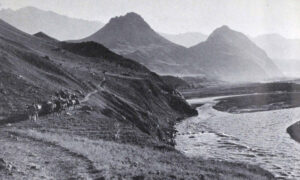
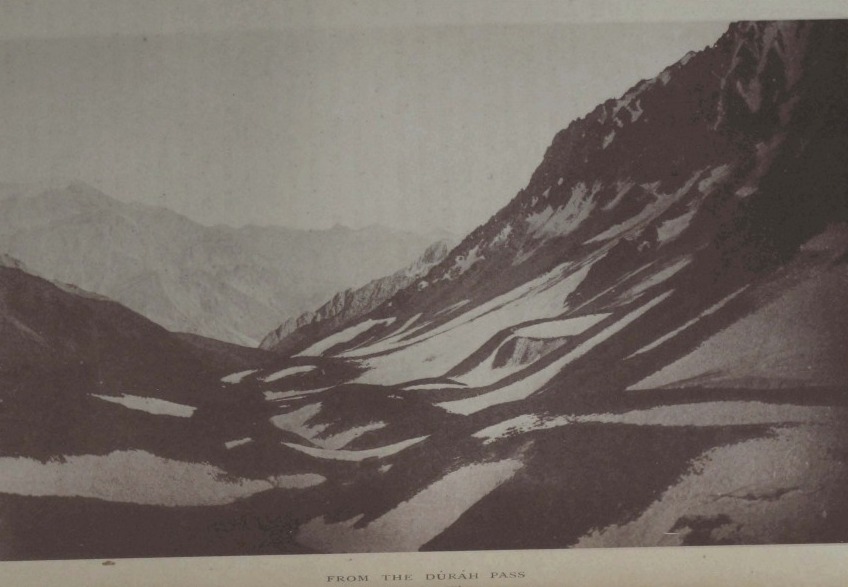
View down from the Dorah Pass Chitral. Elevation 4400 metres (14800 feet). In the middle a newly converted to Islam (sheikh) on horseback. Picture by Georg Morgenstierne, 1929
By Ali Akbar Qazi
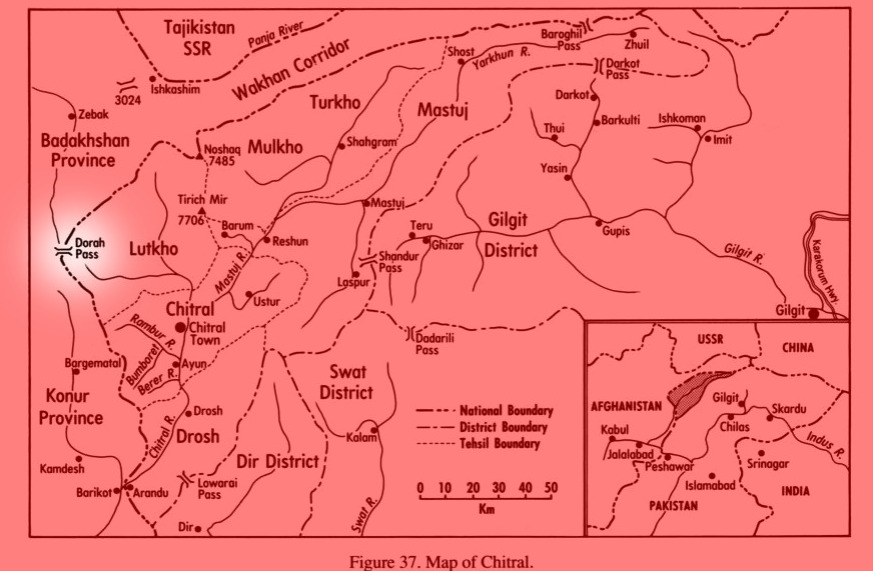
Dorah has historically been the busiest, closest, and safest route for the Hajj caravans, invaders, traders, travelers, migrants, and preachers traveling between Central Asia and today’s Pakistan. Its elevation is nearly 14800 ft /4112m, and it is located along the Durand Line border, crossing the Hindu Kush Mountain range (Faizi,1991).
The distance from Islamabad to Eshkashim (the border town of Tajikistan) via the Chitral Dorah Pass is almost half (560 km) of the distance compared to the Islamabad-Torkham-Kabul-Tajikistan route (1050 km). Constructing a tunnel at Dorah Pass would further decrease this distance.
Reports also reveal that to connect with Central Asia through Dorah Pass, 85% of the route crosses Pakistani territory, while in the case of Torkham, 77% crosses Afghan territory, making Dorah an ideal point for connectivity. Additionally, the Government of Pakistan and the CPEC authority have decided to build an alternative CPEC route through Chitral via Shandur. In this context, the proximity of the Dorah border will create broader opportunities for economic ties between China and Central Asia. (Interview with Mr. Wazir Zada, Ex. Provincial Minister, KPK)
Also Read: TRADE LINKS IN THE EASTERN HINDU KUSH: THE CHITRAL ROUTE
One of the strengths of this border is that it is very close to populated areas on both sides. In Chitral, the nearest village to Dorah is Shah Salim Gobor, about 20 km away, while Sanglich Badakhshan (the closest populated area on the Badakhshan side) is roughly 40 km from the main border. Mr. Sultan Mehmood, who previously served as the Provincial Community Development Manager with AKDN in Badakhshan and often traveled through the Dorah Pass, shared that someone leaving on foot from Gobor Valley early in the morning can reach Sanglich by evening. However, traveling by vehicle, the trip from Shah Salim (Chitral) to Sanglich (Badakhshan) takes about four hours.
A well-known researcher, traveller, and linguist, Morgenstern (1929), who had visited Northern Areas and Chitral, writes, “From Shah Salim, I ascended the Dorah Pass (14800 feet), one of the most important Hindu Kush passes. The Dorah is quite easy, and the distance between inhabited places on both sides is not very great” (p.44).
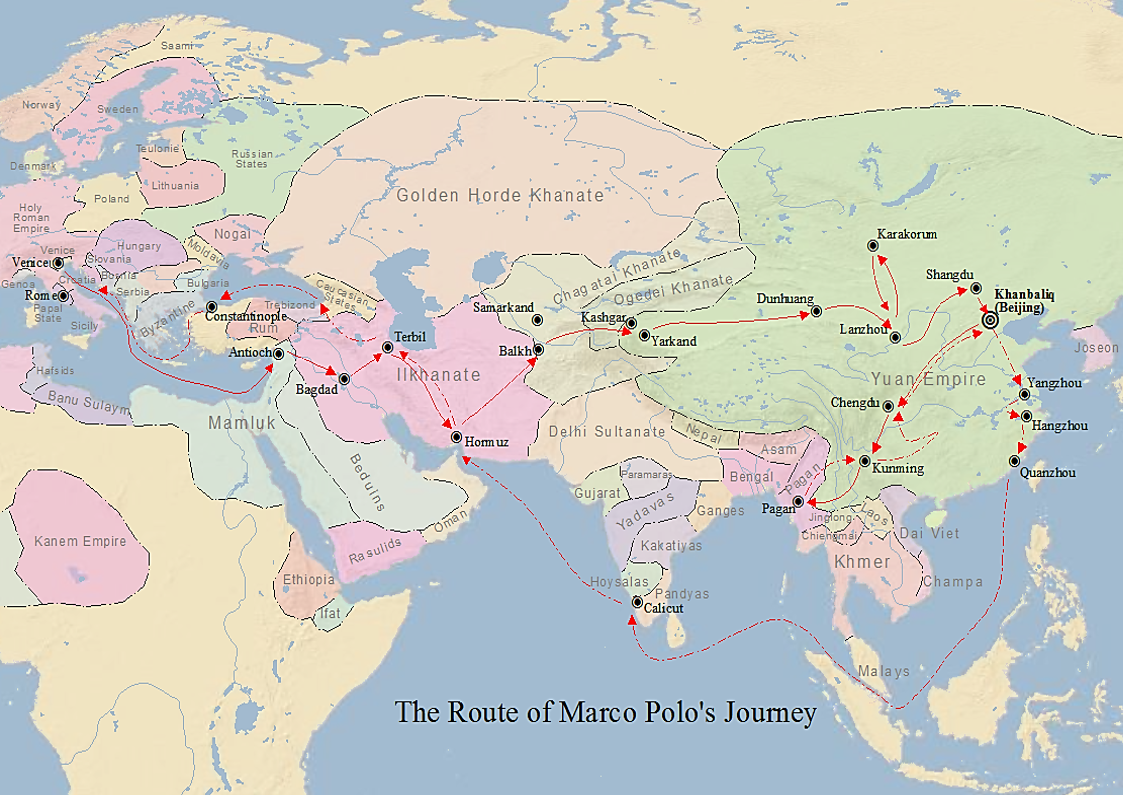
Historically, numerous accounts indicate that this route was part of the ancient Silk Road, connecting Central Asia with China and its surrounding regions. In addition, people living on both sides of the border have shared similar cultural heritages, traditions, and way of life, which indicates their long-standing relations through this border. Ancient sources indicate the influence of some major early religions in Chitral, especially Zoroastrianism, Buddhism, and Kalasha, which had access to Chitral and Gilgit through key borders like the Dorah and Broghil.
Also Read: 2021: Georgian Mountaineers Climb Saraghrar Peak (4349m)
A very credible source, an old book, Hudud al-Alam, written in 372/982AD on Persian geography, provides comprehensive information about the utilization of the Dorah and Broghil passes. The mentioned book, which is translated by Minorsky (1930), says, “Once in Shughnan (usually merged in Vakhan), the merchants could follow up the stream or cross into Chitral and Gilgit by the well-known passes in the Hindukush (Dora and Baroghil)” (p.364). It evidently shows that in the 10th century these passes were being used by the traders, and this process of communication, transportation, and travel has continued throughout history. Another Central Asian expert, Wood J., 1841, in his book (A Personal Narrative of a journey to the sources of the river Oxus, by the route of the Indus, Kabul, and Badakhshan), while discussing this long trading relationship, says,
…. with forty iron pots …loaded [on] five yobus [packed horse], and made his way to Chitral. Here he [Trader] readily disposed of them, and after investing part of the proceeds in honey, started for the Chinese frontier… where he [trader] safely arrived and sold his Chitral investments to such advantage that he cleared fourteen times the value of his original venture-the forty cast–iron pots. (pp. 290-91)
Besides invasions and business purposes, this border has also been used by famous saints, mystics, and religious preachers in different periods of time. As mentioned earlier that the presence of a few old religions in Chitral has been verified by many prominent historians and writers like Karl Jetmar (1996), Faizi (2005), Ghufran (1962), Cacopardo Brothers (2001), Baig (2004), and Najeeb (2000). It reveals the arrival of respective preachers from Central Asia to Chitral and Northern Areas to spread Buddhism, Zoroastrianism, and Kalasha beliefs because it is clear that Central Asia and ancient Persia have been the centers for the spread of these major religions.
Most historians agree that, like other ancient religions, Islam also entered Chitral first time from Central Asia through a famous Central Asian Fatimid Ismaili Dai, philosopher, and Traveler, Nasir Khusraw, in the 11th Century via the Dorah border. The Astana (Ziarat) of Nasir Khusraw in Garam Chashma Chitral is one of the strong pieces of Central Asian religious influence and shared ritualistic expressions.
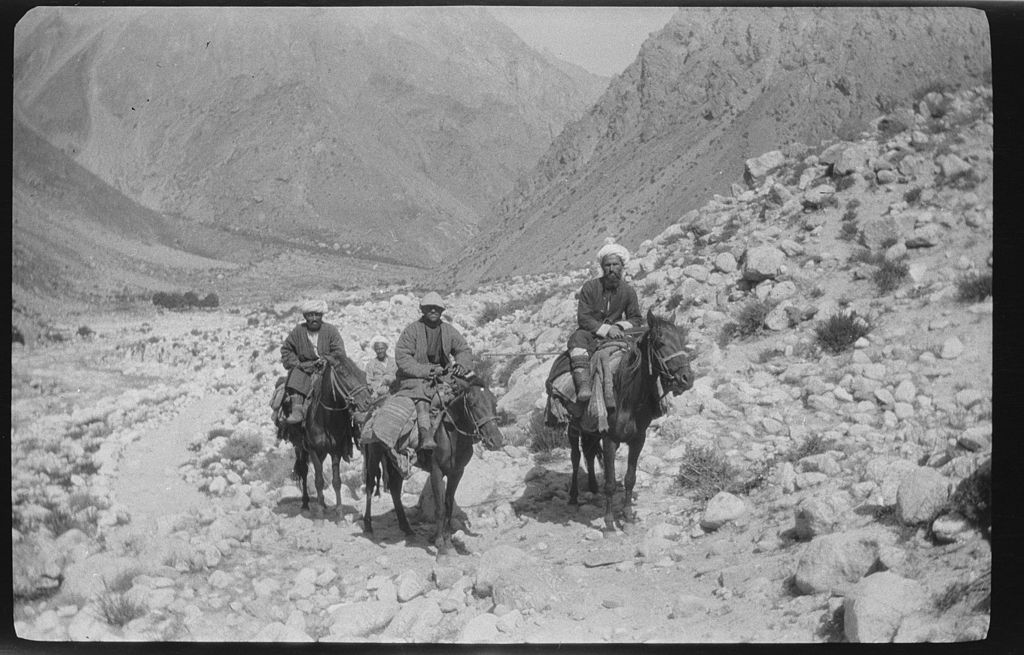
In addition to this, we see, different tribes of Chitral had mostly migrated from Badakhshan, Tajikistan, Uzbekistan, and Kyrgyzstan, still having their family historical connections with their respective areas, and share common cultural heritage. Their historical connections and travels have also been maintained through these important borders, i.e., Dorah and Broghil. According to Amin Mohammad (a writer and social worker), during the 20th century, a prominent historical figure of Chitral, Sher Afzal, an exiled brother of the ruling Mehtar, utilized the Dorah Pass to launch an attack on Chitral with the backing of the Afghan monarch, Amir Abdul Rehman. Despite its historical significance, this strategically vital border remained largely overlooked in global discourse until it first drew international attention during the Soviet invasion of Afghanistan.
Road Construction and Trade Relations in the 1980s and early 90s.
During the former Soviet Union’s invasion of Afghanistan in the 1980s, the Dorah border played a key role in facilitating the Mujahideen’s resistance against the Soviet army. As a native of Garam Chashma, Chitral, the author of this paper witnessed the situations and events that unfolded during the 1980s and early 1990s. At that time, Pakistan, in close collaboration with the United States of America and some Arab countries, supported the Mujahideen in pushing back the Soviet forces from Afghanistan.
The Soviet invasion of Afghanistan was not only an attack on a sovereign nation, but it also posed an existential threat to Pakistan. As Pakistan shares a 2640 km-long border with Afghanistan, the risk of the Soviet war expanding to Pakistan was strongly felt. Therefore, Pakistan’s alliance with the US and some Arab nations supported the Mujahideen’s resistance. Dorah was one of the busiest borders used by the Mujahideen to fight against the Soviet forces. This was the time when millions of Afghans migrated to Pakistan through different borders, including Dorah.
During the late 1980s, two major ammunition camps were established in Garam Chashma, Chitral, strategically positioned near the Dorah border. These camps served as major supply hubs for providing weapons and logistical support to two different fighting groups in the Badakhshan province of Afghanistan. The author also recalls the catastrophic explosions that destroyed both camps, claiming precious lives of over 40 people working and living near the camps.
During late 80s and early 90s, a jeepable road was constructed from both sides and there was a bilateral business continued, for instance, Afghan used to bring livestock, gemstones, Lapis Lazuli, styrax, utensils, carpets, handicrafts, herbal medicines, and a few edible things to Garam Chashma, on the other hand they used to purchase almost all human necessities like food, cooking oil, sugar, rice, fabrics, etc.
According to a report published in a credible online newspaper, Chitralnews, the Dorah (Gobor) route was the largest source of revenue collection for the district council in the form of octroi tax. Till the 1990s, full-loaded vehicles used to travel from Garam Chashma to different parts of Badakhshan, mostly Faizabad. Local drivers used to travel to Afghan-Badakhshan daily, and there was no restriction on any kind of movement.
One of the well-known transporters, Mr. Nawab Khan, currently serving as the Chairman of the Village Council, shared his experience as a frequent traveller between Garam Chashma and Badakhshan in an interview: “It used to be an almost 14-hour journey from Garam Chashma to Faizabad in Badakhshan. Drivers would load various goods into their vehicles and navigate rough, bumpy roads to reach their destination. The route was generally safe and hospitable in terms of security. I recall several occasions when our vehicles broke down along the way, yet we never encountered any security threats.” (Interview with Mr. Nawab Khan, Chairman Villag Council)
Contemporary Situations and Govt. Initiatives
The utilization of this border has always been subject to the relations between Pakistan and Afghanistan. Since the USSR’s collapse, this border has remained partially closed while local communication, trade, and travel have continued from till 1997. Inayatullah Aseer, a well-known social worker, reports that in 1992-93, under the guidance of Prime Minister Nawaz Sharif, the Government of Pakistan conducted an extensive survey from Chitral to Eshkashim, Tajikistan, in which he participated in the mission as the Manager of Administration.
The team traveled by jeep from Chitral to Faizabad and onward to Eshkashim. According to him, the total distance from Chitral to Eshkashim is approximately 200 kilometers. This initiative resulted from the first bilateral discussions between the two countries aimed at connecting Tajikistan to Gwadar via the Dorah Pass following the collapse of the Soviet Union.
Also Read: 1985: Russian Air Attack on Chitral
Later, in December 2010, Pakistani President Asif Ali Zardari and Tajik President Emomali Rahmon met on the sidelines of the Economic Cooperation Organization (ECO) summit held in Turkey. They agreed on exploring various modes of regional connectivity, with the Chitral–Tajikistan route identified as one of the key options. Unfortunately, these important initiatives could not be completed due to political instability and external interference.
During the year 2019, the Provincial Government took the initiative to work on the two cross-border trade. i.e., Arandu and Dorah in Lower Chitral, which, due to security concerns and the Taliban’s invasion of Afghanistan, did not take practical implementations. (Interview with Mr. Sartaj, Former Tehsil Nazim of Chitral). Furthermore, one important aspect that should not be ignored is that these kinds of initiatives cannot be realized without ensuring security clearance. This is a harsh reality in a country like Pakistan, which faces significant security concerns on various borders, and it is not easy to make decisions quickly regarding any political and economic relations without addressing security measures.
Conclusion and Recommendations
No one can deny the strategic importance and historical significance of Dorah, keeping in view the contextual realities and contemporary political situations. It shares one of the shortest and safest borders with Badakhshan, which is one of the richest provinces of Afghanistan in terms of minerals and other natural resources. This also connects Pakistan with Central Asian republics via Tajikistan by crossing the very shortest distance in the Wakhan corridor. The Government of Pakistan and its business community not only have significant commercial opportunities in the Badakhshan region, but such engagement could also open new horizons for trade and economic cooperation with the Central Asian Republics.
Also Read: 1955: The First Ascent of Istor-o-Nal Peak
We can create direct sustainable business linkages with Central Asian Countries, which are rich in natural resources like Gas, Minerals, and Petroleum. On the other hand, Pakistan can have exchange business opportunities like medicines, fabrics, food items, petrochemicals, automobile lubricants, and fruits, etc., which have a high demand in Central Asian countries.
Secondly, connecting the Dorah border with the CPEC route will definitely open wonderful opportunities for Pakistan to have economic relationships with China and the Central Asian republics simultaneously. As Islamabad-Dorah-Tajikistan is the shortest route, which passes through 85% of Pakistani territory will provide more business opportunities to the people of Pakistan living around the expected connecting route. There have been several official attempts by the government to construct a road from Chitral to Garam Chahsma-Dorah Pass; however, none of them have materialized successfully. For instance, in 2022, the National Highway Authority (NHA) floated a tender for this route with complete details, but the project was abruptly halted without any clear or comprehensive justification.
Also Read: Rahman Qul and Kirghiz Nomads: A Story of Exodus and Transition
Thirdly, as it is being said that Pakistan is a cultural extension of Central Asia, this connectivity will also offer huge facilitation to our tourism industry when we create better infrastructure for travel and to appreciate the diversity of culture and traditions. It has been observed that most Western tourists want to explore the old Silk-route and wish to travel to all the connected countries by crossing these borders. Certainly, if we become successful in materializing this idea, it will invite people from different parts of the world, which will have a very positive impact on our economy too.
References
Anonymous (982/1980). HUDUD: The regions of the world: A Persian Geography. [V. Minorsky, Trans.]. Karachi: Indus Publications, Abdullah Haroon Road Karachi.
Baig K. R. (1996). Defense Organization of the former State of Chitral: Strategy of Collective Responsibility. In Bashir, Elena, & Israruddin (Eds.), Proceedings of the Second International Hindu Kush Cultural Conference (pp.138-146). New York: Oxford University Press.
Bhamiani, I. B. (2000). Burhanul Awlia Badakhshan Mai. [Burhanul Awlia at Badakhshan,
Biddulph, J. (1971). The tribes of the Hindukush. Karachi: Safdar Mahandi Publishers Karachi
Faizi, I. (1991). The geo-political significance of the southern passes of the Wakhan corridor. Unpublished Ph D thesis from Peshawar University
Ghufran, M. M. (1962). Nayi Tarikh-e-Chitral [Urdu: New history of Chitral] (G. Murtaza, Trans. from Persian into Urdu). Peshawar: Public Art Press.
George Morgenstierne,1932, Report on a Linguistic Mission to North-Western India.
Ivanow. W. (1948). Nasir Khusraw and Ismailism. India: Ismaili Society Bombay.
Jettmar. K. (1980). Balor and Darditstan. Islamabad: National Institute of Folk. Jettmar. K. (1996). Approach to the history of North Pakistan. In E. Bashir & I. Din (Eds), Proceedings of the Second International Hindu Kush Cultural Conference (pp.77-96). New York: Oxford University Press.
Qazi, A. A (2006). Phatak: A beautiful festival. Unpublished paper.
Provincial Govt Survey Report, A Letter of Ex. Minister Wazir Zada Sb to the Federal Minister of Communication, Pakistan in 2020-21.
National Highway Authority NHA Pakistan, tender notices, and updates on developments.
Letter to Federal Minister for Communications, Pakistan by Ex. Provincial Minister Wazir Zada Dated: April 2020
Interviewes
Mr. Wazir Zada (Ex. Provisional Minister)
Mr. Sultan Mehmood (Ex. Provincial Community Development Manager, AKDN, Badakhshan)
Mr. Sartaj Ahmad Khan, Ex-Tehsil Nazim Chitral
Mr. Nawab Khan, (Chairman, Village Council Garam Chashma
Mr. Inayatullah Aseer (Social Worker, Ayon Chitral)
Websites Consulted
https://www.worldhistory.org/uploads/images/10041.png?v=1618175703
https://chitraltoday.net/2021/09/26/cpec-and-dorah-pass
Posted on 9 July 2025